

Selling Online · Part 2 of 2
Shopify vs Custom Website: The Honest Trade for a Small Shop
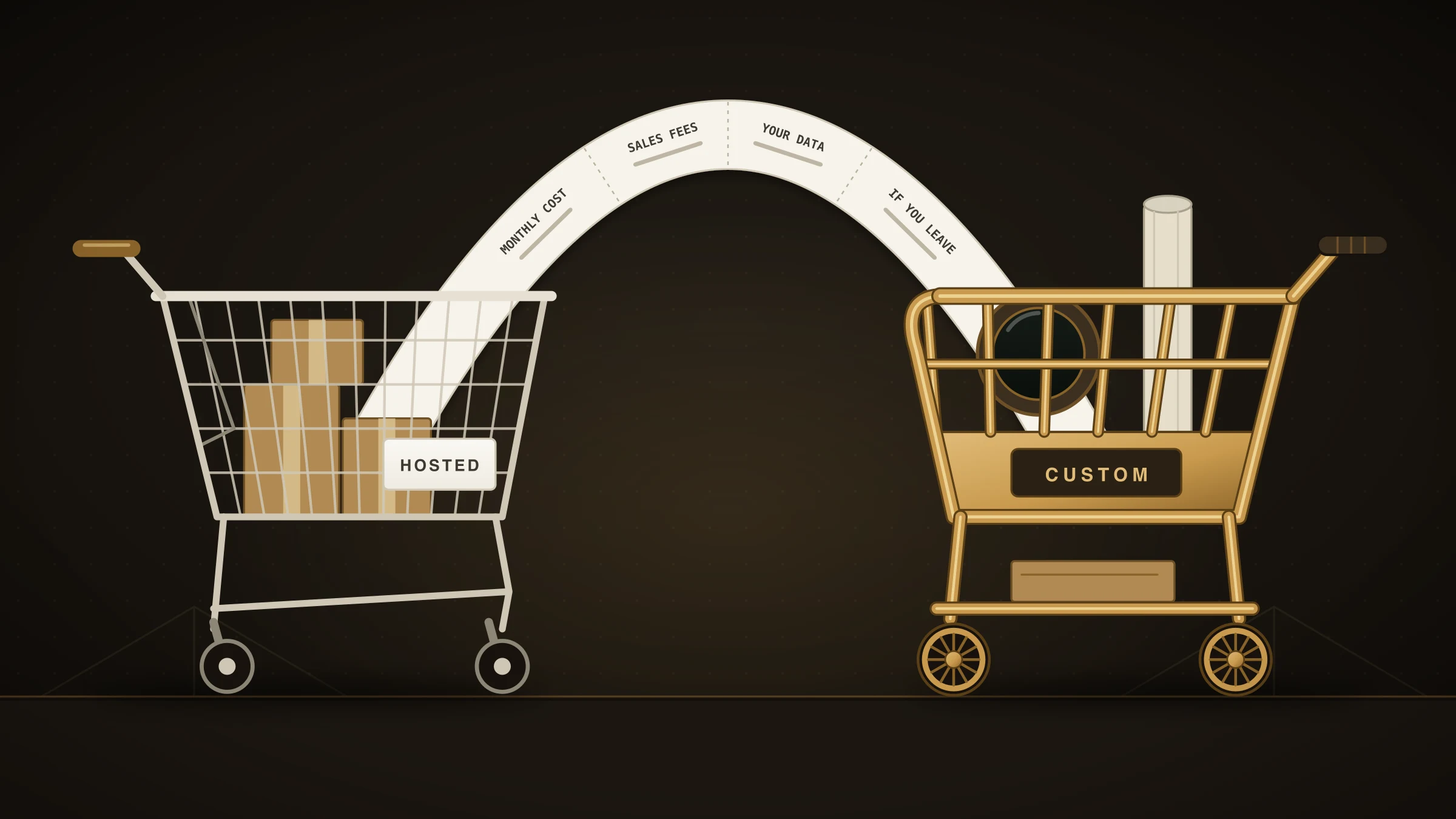
You have decided to sell online, and now two people are giving you opposite advice. One says open a Shopify store this weekend. The other says a real business needs its own custom website. Both are right for somebody, and the question is which somebody you are.
We build custom online stores for small shops, and the FAQ on that page says outright that a platform store is sometimes the better choice. This post is the longer version of that answer.
If you are still deciding whether to sell online at all, start with our checklist on whether a small business should sell online and come back.
Shopify vs custom website: what you are choosing between
A hosted platform is rented space in a very good mall. The building, the checkout, the security and the upgrades are handled for you. You pick a theme, load your products and open. You pay a monthly subscription plus payment and app fees, and you follow the mall's rules.
A custom store is your own building. Someone designs it around how you sell, and it can do things the mall does not allow. In exchange you depend on whoever built it, and it costs more to set up or to keep.
Neither is the grown-up choice. The US Census Bureau estimates that e-commerce made up 17.1 percent of total retail sales in the second quarter of 2026, across all US retail. The shoppers placing those orders neither knew nor cared what the store was built on.
When Shopify is enough
Pick the hosted platform, and do not let anyone talk you out of it, if most of these are true:
Your catalog is simple. A few dozen products with a price, a photo and perhaps a size or colour.
You want to run it yourself. You are comfortable adding products and changing prices, and you do not want to call someone to do it.
You need it soon. In our experience a platform store can be live in days.
You ship in the ordinary way. Standard boxes, standard carriers, standard rates.
You are testing. You do not yet know whether online orders will be worth the trouble.
There is also a point in the platform's favour that custom builders rarely mention: checkout. Baymard Institute puts the average documented cart abandonment rate at about 70%, averaged across 50 studies of varying age and method. In its survey of why shoppers abandon at checkout (people who were "just browsing" were excluded), 19% said they did not trust the site with their card information and 17% said the checkout was too long or complicated. A big platform's checkout is familiar and well tested. A custom store has to match that standard, which is why ours hand payment to an established processor.
This is the same trade we described for brochure sites in DIY website builder vs hiring a pro. The do-it-yourself route is a good one until your business stops fitting the template.
When a custom store earns its cost
A custom build starts paying for itself when the shop does something the template was not designed for. In our work the usual cases are:
Unusual products. Custom artwork, made-to-order items, engraving, anything where the customer uploads a file or the price depends on choices.
Pickup rules. Certain items are collection only, pickup happens on certain days, or stock sits in two places.
Orders that need to go somewhere. Into your accounting, a production queue, or a supplier's system, without someone retyping them.
Local search. You want the store to rank for what you sell in your area, with pages written for local buyers.
A stack of apps. You are already on a platform and paying for five add-ons to make it behave. At some point the add-ons cost more than building the behaviour once.
If none of those describe you, a custom store is a nicer sign on the same shop. Save the money.
Compare these four things before you pick
Monthly cost. Add up everything, not just the headline. On a platform that is the subscription, the theme if it is paid, and each app. With a builder it is the build fee if there is one, hosting, and what changes cost. We do not quote any platform's rates here because they change. Check the current ones yourself and put both totals on one sheet of paper. Ours are on the pricing page.
Fees per sale. Ecommerce platform fees and card processing fees both come out of every order, so they matter more as you grow. Every store pays card processing, custom or not. Ask what is charged on top of it, and whether using your own payment processor changes the rate.
Who controls the data. Store ownership has three parts: the domain name, the product catalog, and the customer and order history. The domain should be registered in your name whichever way you go. Then ask how you would export the products, customers and orders, and in what format. Ask a custom builder the same question, us included. A builder who will not answer it is a worse landlord than any platform.
What happens if you leave. Products and customers usually travel. The design, and anything an app was doing for you, usually does not. What matters most for search is that the old addresses keep working. Google's guidance on site moves says permanent redirects do not cause a loss in PageRank and should stay in place for at least a year. So a move in either direction is survivable if someone maps the old addresses to the new ones. Expect search visibility to wobble for a few weeks while it settles, which Google describes as normal.
How to decide
Write down what makes your shop awkward: the product nobody else sells the way you do, the pickup rule, the spreadsheet you retype orders into. If the list is empty, start on a hosted platform and spend the difference on good photos. If it is long, a custom store is worth a conversation. We are a small Metro Detroit firm, and you can send us the list for a free review. If the right answer is the platform, that is what we will tell you.
Comments
Be the first to comment.