

The Small Business Website Playbook · Part 7 of 9
How to Choose a Web Designer Without Getting Burned
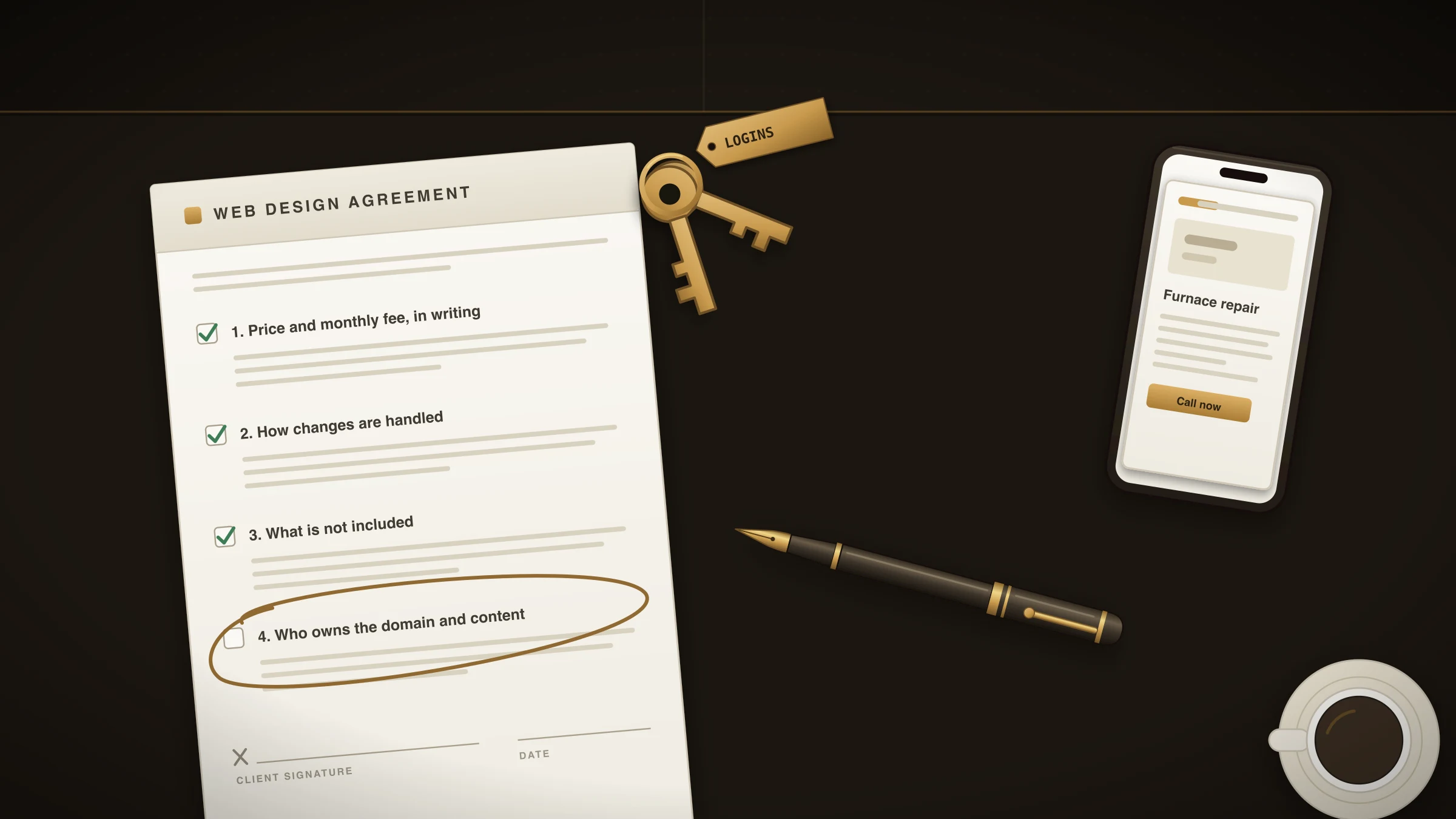
You are about to hand a stranger a few thousand dollars and the front door of your business, and you have no real way to judge the work. Most owners we meet in Michigan already have a story about it. The nephew who stopped answering. The firm that kept the domain. The site that looked fine on launch day and could never be changed afterward.
Working out how to choose a web designer has very little to do with taste. It comes down to six plain checks, and they apply equally to a freelancer, an agency, a builder subscription you run yourself, and us. We build sites as part of our website and online presence service, and we would rather be asked these questions than not.
One note first. If you have not decided whether to hire anyone at all, read DIY website builder vs hiring a pro. A new, unproven business is often better off with the cheapest builder and a free weekend. This post assumes you have decided to hire.
Step 1: Open their live sites on your phone
Portfolio screenshots are chosen and cropped. Ask for three sites that are live today, built for businesses about your size, and open each one on your phone using cell signal, not the office wifi.
You are checking four things:
Does it load quickly?
Can you tell within five seconds what the business does and where it is?
Is the phone number or the form one tap away?
Does it still look cared for, or are the hours wrong and the last update two years old?
The last one tells you the most. In a Visual Objects survey, 76% of consumers said they look at a business's online presence before visiting in person. A site that was abandoned after launch is what those people find, and it tells you how this designer's work ages.
A newer freelancer may only have one or two live sites to show. That is not a disqualifier. Just weigh the thinner track record when you compare prices.
Step 2: Ask who owns the site, the domain and the content
This is where owners get burned most often, and it is rarely malice. The designer registers the domain in their own account because it is quicker, and five years later nobody remembers the login.
So ask it straight: when the work is finished, who owns the site, the domain name, the words and the photos?
A good answer sounds like this. The domain is registered in your name, in an account you can log into, from day one. The writing and the photos you paid for are yours to take with you. You are an owner on the Google Business Profile and any analytics account.
The design itself is a fair place for the answer to vary. A site built on a designer's own platform, or on a subscription builder, often cannot be picked up and moved somewhere else. That can be a reasonable trade for a lower price. What matters is that you hear it before you sign and not on the day you want to leave.
Step 3: Ask what happens after launch
A website is finished the way a work truck is finished. Software needs updating, hours change, a service gets added, a photo goes out of date.
Ask who does that work, how fast, and what it costs. Three answers are all legitimate:
"You do, and we will show you how."
"We do, at this hourly rate."
"It is included in the monthly fee."
The answer to worry about is the vague one. Pin it down with the request you will make most often: what does a small text change cost, and how long does it take?
Step 4: Get the price and the monthly in writing
You need a rough sense of the market before a quote means anything. Industry pricing guides from ManyPixels and GruffyGoat put a professionally built small business website at roughly $2,000 to $8,000 up front, with ongoing domain, hosting and maintenance commonly $150 to $500 per month. Freelancers run about $1,500 to $8,000 and boutique agencies $6,000 to $35,000 and up.
A quote outside those ranges is not automatically wrong, but it needs an explanation. We went through the numbers in more detail in what a small business website costs in Michigan.
Whatever the figure, get it on paper. A web design contract, or even a one-page written quote, should state:
The up-front price and when each payment is due
The monthly fee and exactly what it covers
How many pages and how many rounds of changes are included
Who supplies the writing and the photos
The timeline, and what happens if either side misses it
What you keep if you part ways
If a designer will not put the monthly cost in writing, stop there.
Step 5: Ask the questions most owners skip
A few more questions to ask a web designer rarely come up until it is too late:
Who will do the work, you or someone you hire out to?
Will I be able to log in and change a price or a photo myself?
What do you need from me, and by when?
How do I reach you when something breaks, and how quickly do you answer?
Can I talk to a client you have worked with for more than a year?
None of these are trick questions. You are listening for whether the answers come easily. Pay attention to the third one. In our experience most late websites are late because the owner's own content was. A designer who tells you up front what they need from you, and when, has done this before.
Step 6: Choose the web designer who says what they will not do
Every provider has edges. A freelancer may not write your copy. An agency may route everything through an account manager. A builder gives you the tools and leaves the rest to you. We work on a fixed monthly fee, which does not suit an owner who wants to pay once and never think about it again.
Ask two things: what do you not do, and who is a bad fit for you?
Someone who can answer both has done enough projects to know where theirs go wrong. Someone who says "we do everything" either has not, or is going to hand part of your job to a person you never meet.
What to do this week
Pick two or three candidates and send each of them the same questions. Put the answers side by side and the differences show up quickly.
If you would like us to be one of the three, ask for a free review and hold us to every step above. Our monthly pricing is published, so you can set our number beside the others before you speak to anyone.
Comments
Be the first to comment.