

The Small Business Website Playbook · Part 11 of 11
The 2026 PHP Vulnerability: What It Means for WordPress Sites
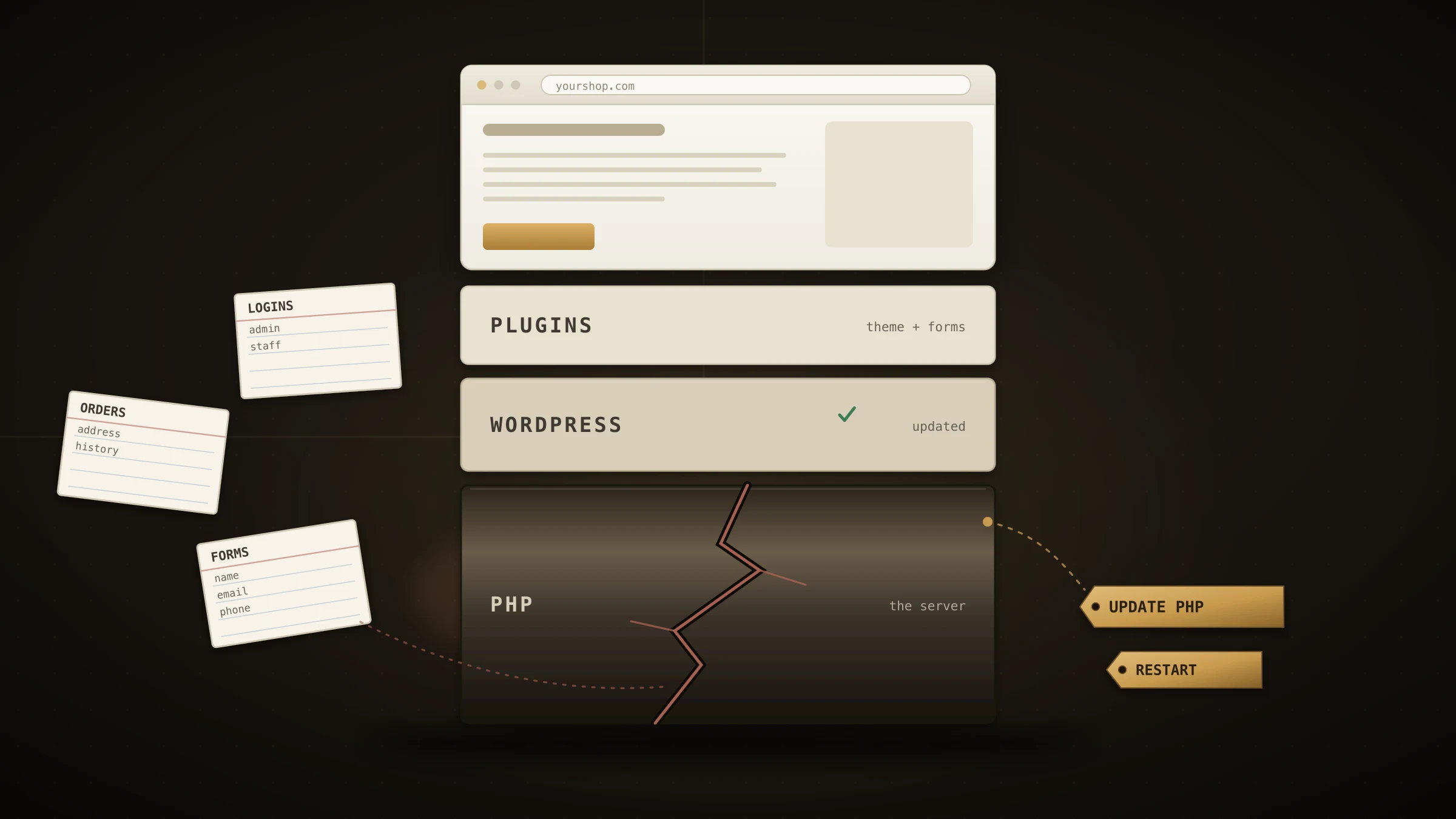
If your business website runs on WordPress, a problem surfaced in late October that has nothing to do with your plugins or your theme. It sits one layer down, in the software that runs WordPress itself, and it lets a stranger take over the server your site lives on without ever logging in.
This is the 2026 PHP vulnerability, two flaws that security teams nicknamed "php2shell." Below is what it is in plain English, what it puts at risk for your business, and the short list of questions to send whoever runs your site. If someone else hosts and updates your site, the way we do for clients on our managed website service, this is the week to confirm they handled it.
What the PHP vulnerability is, in plain English
A website has two parts. There is what visitors see, and there is a program on a server that builds each page when someone asks for it. For WordPress, that program is written in a language called PHP.
PHP is everywhere. According to W3Techs, it runs 69.1% of the websites whose server language is known, WordPress sites among them.
On October 21, 2026, the PHP team released fixes for two critical flaws and told everyone to update. Their security advisory says the risk covers every PHP installation that serves web pages, and that on one common setup the attack can start before any WordPress code runs at all. Five days later, CISA, the federal cybersecurity agency, added both flaws to its Known Exploited Vulnerabilities catalog. That list is only for flaws with reliable evidence that attackers are already using them.
The technical name is "unauthenticated remote code execution." In plain terms, someone on the internet can make your server run their commands, with no password.
What it puts at risk: your business data
Think of the server as the back office. Your website is the front counter, and this flaw hands a stranger a key to the back door.
What sits in that back office on a typical small business WordPress site:
Form submissions, if your form plugin keeps copies: quote requests, contact forms and job applications, with names, emails, phone numbers and addresses.
Customers and orders, if you sell online: accounts, shipping addresses and order history.
Logins for you and your staff.
The keys to the database. WordPress keeps its database connection details in a single settings file on the server. Whoever can read that file can reach everything above.
Google's security team puts the stakes bluntly: attackers "can crash and hijack the affected system, and can easily steal, alter, and wipe its data." The same flaws can also leak pieces of the server's working memory to an attacker.
For an owner, that turns into three kinds of trouble. Customer information you collected is now in a stranger's hands. Your site can be quietly changed to send visitors somewhere else. Or the site and its records are simply gone.
Updating WordPress does not fix this
Most owners who do any upkeep know to update WordPress and its plugins. That is still right, and it does not help here. The flaw is in PHP, underneath WordPress, so the fix is a PHP update on the server, made by whoever controls that server. This year the most important WordPress security job sits outside WordPress.
The fixed versions are PHP 8.5.12, 8.4.27, 8.3.36 and 8.2.35. Google's guidance adds a step that is easy to miss: after the update, the server's PHP processes have to be restarted, or the old copy keeps running.
The sites with no fix coming
Here is the part that should worry owners of older sites. The PHP project no longer updates version 8.1 or anything older. Some hosting companies patch older versions themselves, but there is no official fix.
That is not a small group. On November 1, WordPress.org's own statistics showed 32.9% of reporting WordPress sites on PHP 8.1 or older, about a third. CISA's advice for systems that cannot be updated, or that run 8.1 or earlier, is to take them offline.
Version 8.2 is fixed for now, but the PHP team says it reaches end of life on December 31, 2026, with no security fixes after that. If your site is on 8.2, plan the move before the new year.
What about other site builders?
Site builders come in two kinds. Hosted builders run the servers for you, and you never pick a PHP version, so patching is the platform's job. WordPress is software that runs on a server someone chose and someone maintains. That someone might be a hosting company, a web designer, a relative who set it up years ago, or you. This vulnerability lands on whoever that is. We compared the two approaches in DIY website builder vs hiring a pro.
Frequently asked questions
Does my WordPress site use PHP?
Yes. WordPress is written in PHP, so every WordPress site runs on it. The only questions are which version, and who updates it.
How do I check my PHP version?
Log into WordPress and open Tools, then Site Health, then the Info tab. The Server section lists the PHP version. Compare it with the fixed versions above.
Was my site hacked?
You cannot tell from the front of the site. Ask your provider when PHP was updated and restarted. If the site ran an unfixed version after October 21, ask them to check for signs of a break-in and to change the admin and database passwords.
What should I ask my web provider?
Three questions, in writing. Which PHP version is my site on today? Was it updated to a fixed release after October 21, and were the PHP processes restarted? If we are on 8.2 or older, when is the upgrade scheduled?
Is an online store at higher risk?
A store holds more than a brochure site does: customer accounts, addresses and order history. The fix is the same, but the stakes are higher, so check the store first.
The next step
Send those three questions this week. Keeping PHP current is part of what website maintenance should cover, and it is the part most often skipped because nobody sees it.
If you do not know who runs your server, or the answer comes back 8.1, ask us for a free review. Our plans host, secure and update the site for a fixed monthly price, and Metro Detroit owners get a straight answer within one business day.
Comments
Be the first to comment.