

How Search Works Now · Part 1 of 1
How SEO and AI Search Actually Work: Your Website Is the Source
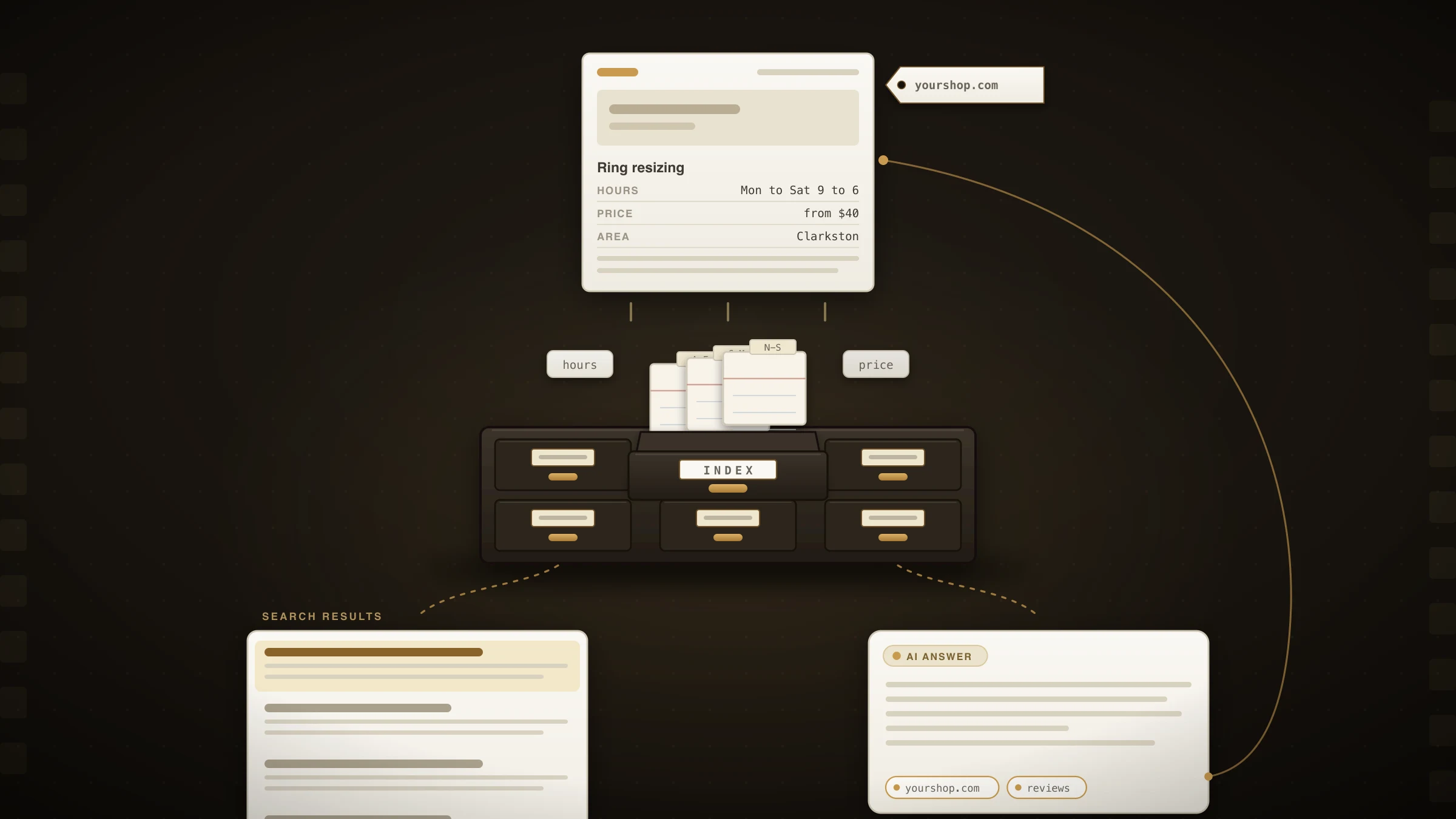
A lot of owners have heard the same thing this year: people ask an AI now, the AI just knows the answer, so websites are on their way out. It is an understandable guess. It is also wrong about where the answer comes from, and the mistake is expensive if you act on it.
So how does AI search work? The short version is that an AI answer is built out of web pages. Somebody's website was read, stored, pulled back out, and summarized. If your business is in the answer, it is because a page about your business was in that pile. If it is not, usually no such page existed, or it could not be read.
This post walks the whole pipeline, for classic search and for AI search, because they share almost all of it. We do this work every day as part of our local SEO and AI search service, and the single most useful thing we can tell an owner is that the two are not rivals. They are one system with two different front counters.
The pipeline every search engine runs
Google describes its own process in three stages, and it is worth reading in their words. According to Google's guide to how Search works, the stages are crawling, indexing, and serving results.
Crawling. Automated programs called crawlers visit pages and download what is on them: the text, the images, the links to other pages. A crawler finds your site by following a link to it or by reading a sitemap you provide. A page nobody links to and no sitemap lists may never be visited at all.
Indexing. The engine works out what each page is about and stores that in a very large database. Think of an old card catalog. The library does not hand you the building. It hands you the card that says which shelf holds the book. A page that is not in the index cannot be shown to anyone, no matter how good it is.
Serving. Someone types or speaks a question. The engine looks in the index for the pages most likely to help, puts them in order, and shows them.
Two details in that guide matter for any owner being sold something. Google does not accept payment to crawl a site more often or to rank it higher. And it does not guarantee that it will crawl, index, or show any page, even one that follows all of its guidelines. Nobody can buy a place in the ordinary results, and nobody can promise you one.
If you want the plain version of what ranking takes, our earlier guide, What Is SEO?, covers it. Here we are following the pipe to the other counter.
How does AI search work on top of that?
An AI answer is a different way of serving. The crawling and the indexing still happen first.
When Google shows an AI Overview, it is drawing on pages in its index. Google's documentation on AI features and your website describes these features running searches, sometimes several at once on related subtopics, and the summary that comes back carries links to pages. The same document is blunt about what that means for a site owner. There are no additional requirements to appear in AI Overviews or AI Mode, and no special optimizations are necessary. A page has to be indexed and eligible to be shown with a snippet. That is the entry ticket, and it is the same ticket as ordinary search.
As far as we can tell, the other AI tools do much the same when they answer questions about the world as it is today. OpenAI's documentation on its crawlers describes a crawler whose job is to surface websites in ChatGPT's search features, and it says that sites which opt out of that crawler will not be shown in ChatGPT search answers. Read that sentence again from the other direction. To be shown in those answers, a site has to let the crawler in.
So where do AI answers come from? From pages. A language model on its own knows what was in its training material up to some date, and in our experience it is unreliable about small local facts like who repairs furnaces in a particular township or whether a shop is open on Sunday. For those questions we see the tools search, read what they find, and write from that. When there is nothing to find, the answer either says less or says something about a competitor who did publish.
What AI Overviews sources have in common
We spend a fair amount of time looking at which pages get cited, for our own site and for client sites. The pattern is unglamorous.
They can be read. The crawler was not blocked, the page loads without a login, and the important text is actual text rather than words baked into an image.
They state facts plainly. Who you are, what you do, where you do it, what it costs, when you are open. A summary can only lift a sentence that exists. "We offer a full range of solutions for your needs" gives a machine nothing to quote. "We resize rings in two to three days, from $40" does.
They answer the question that was asked. One page about one thing, with the answer near the top, beats a long page that covers everything a little.
They are labeled. Structured data, sometimes called schema, is a set of machine-readable labels that say "this is a business, this is its address, these are its hours." In our experience it does not lift a page by itself, but it removes guesswork.
They are corroborated. The same name, address and hours appear on the Google Business Profile, on directories, in reviews, on a supplier's or a chamber's website. When an engine names a few businesses, the ones we see named are usually those the rest of the web agrees about.
None of that is new. It is the list a careful web builder was already working from. That is the practical meaning of "AI engine optimization": doing the fundamentals well enough that a machine can read, trust and quote you. Anyone selling it as a separate secret product is selling the same work with a new label.
What actually changes with AI answers
It would be dishonest to say nothing changes. Three things do, and they matter for how you plan.
Fewer clicks on simple questions. When the answer sits at the top of the page, fewer people go on to a website. The Pew Research Center studied the real browsing of 900 US adults in March 2025. About 18% of their Google searches produced an AI summary. People who saw one clicked a traditional result in 8% of visits, against 15% for people who did not. That is an observed difference in one month, not proof that the summary caused it, since the searches that trigger summaries are a different kind of search to begin with.
Fewer names in the answer. A results page lists ten businesses. The summaries we see name two or three. Being one of the pages it reads matters more than it used to, and being eleventh matters less.
More people asking a chatbot. In BrightLocal's 2026 Local Consumer Review Survey of about 1,000 US adults, the share who said they use ChatGPT or other generative AI tools for local business recommendations rose from 6% to 45% in a single year. Google was still first in the same survey, at 71%. So this is an added channel, not a replacement.
Put those together and the picture is not "websites are dying." It is that the quick factual questions (what time do you close) are increasingly answered before anyone reaches you, while the searches that end in a phone call still need somewhere to land: your prices, your photos, your reviews, your booking form. Those are also the pages a summary is built from. The site does two jobs now. It persuades the person who arrives, and it supplies the machine that speaks for you to the person who never does.
What does not change
The website is still the thing being read. That is the whole point, and it is the part the rumor gets backwards.
A business with no site of its own is represented by whatever else is lying around: a half-complete directory listing, a three-year-old social post, a review that mentions the wrong hours. In our experience an AI tool will happily build an answer from those. You do not get a vote on what it says unless you have published the correct version somewhere it can read.
A social page does not solve this. In our experience much of what sits inside social platforms is hard for outside crawlers to reach, and you do not control how it is presented. A site on your own domain is the one place where you set the facts.
What to do about it, in order
Here is the order we work in. It is deliberately boring.
Make sure you can be read. Check that your site is indexed by searching for your own business name and a service. Make sure nothing is blocking crawlers by accident. If you want to appear in AI answers, do not block the AI search crawlers.
State the facts in plain sentences. Name, services, the towns you serve, hours, and a price or a range where you can. Put each service on its own page.
Answer real questions. Write down the ten things customers ask on the phone and answer each in two or three sentences on the relevant page.
Label it. Add structured data for your business details. A competent builder does this as a matter of course; it is part of every site in our website design and online presence plans.
Get the rest of the web to agree. Complete your Google Business Profile, keep your details identical everywhere, and ask happy customers for reviews.
Keep it current. A page that was right two years ago is a liability once the hours change.
Notice what is not on the list: a tool that "submits your site to ChatGPT," a guarantee of placement in AI answers, or a special file that makes an engine prefer you. Google's own documentation says you do not need new machine-readable files or AI text files to appear in its AI features. Treat any promise beyond the fundamentals with suspicion.
Should a small business be using AI at all?
That is a separate question from whether AI can find you, and we covered it in AI for Small Businesses in 2026. The short answer there is that a few uses are worth the time and most of the noise is not. Being findable is the more urgent of the two, because it affects you whether or not you ever open a chatbot yourself.
Where to start
If you take one thing from this, make it the direction of the arrow. AI search does not replace the website. It reads the website. Around Clarkston and across Michigan we see the same thing in almost every first conversation: the business is good, and the web simply does not contain enough true, plainly stated information about it for any engine to work with.
We will look at what search engines and AI tools can currently read about your business and tell you honestly what is missing. That first review is free, and our monthly pricing is published, so you will know the cost before you get in touch.
Comments
Be the first to comment.