

Winning Local Search · Part 6 of 7
How Customers Search for Local Businesses: Your Town Has More Than One Name
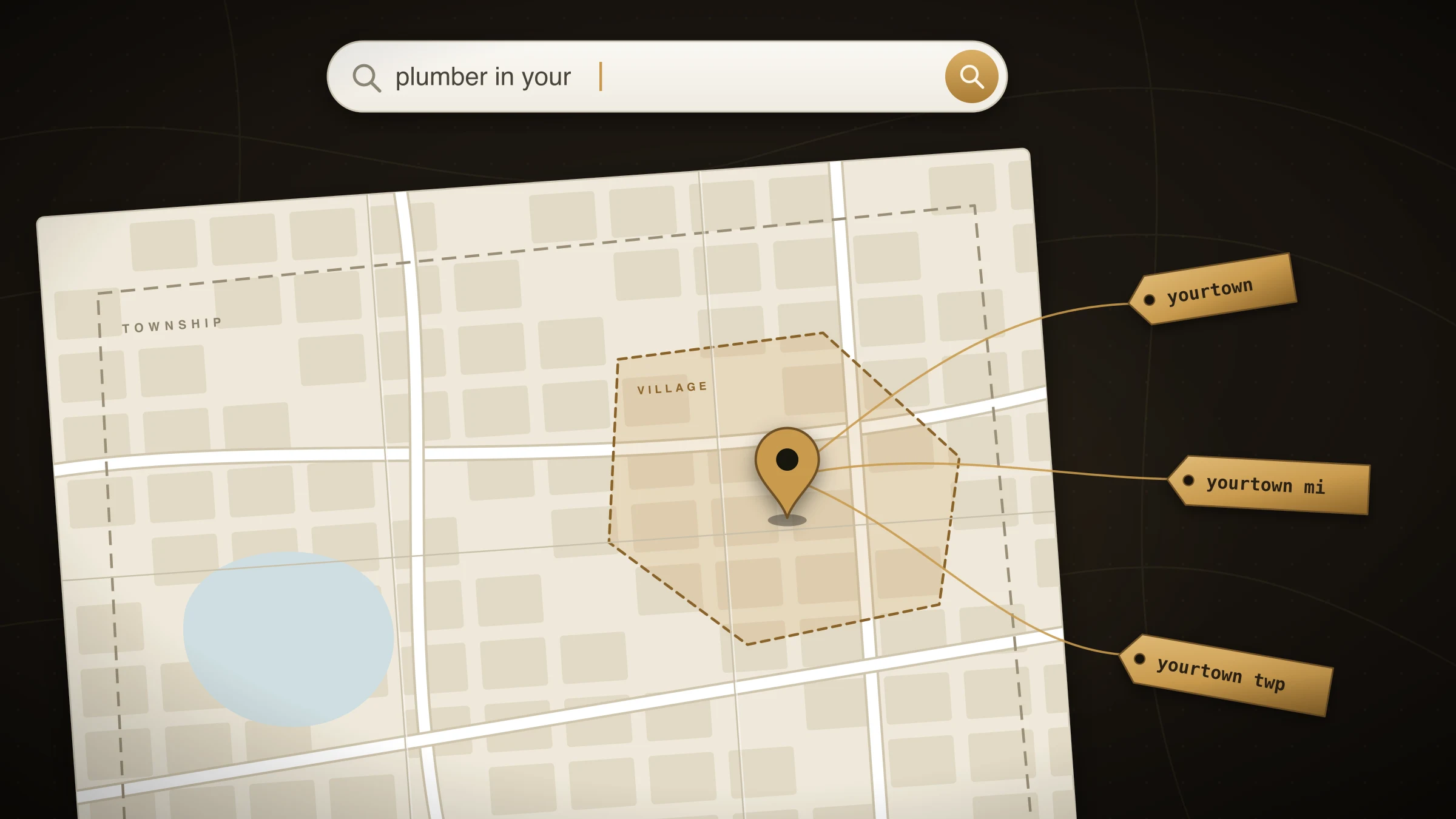
You know what your town is called. It is on the sign, the invoices and the Google profile. But how customers search for local businesses has very little to do with your sign. They type whatever they call the place, and that word is often not the one you use.
Nobody phones to tell you they searched a name you never wrote down. So the gap can sit there for years, quietly sending work to whoever happened to use the other word.
It matters because so much searching is about a place. Back in 2018 Google put the share of searches with local intent at 46%, a figure Search Engine Roundtable reported at the time. Plenty of those carry a place name. The question is which one.
What people type around Lake Orion
Take the town twelve minutes east of our Clarkston office. Ask an owner there where the shop is and you will hear "Lake Orion". It is a village with a walkable downtown of boutiques and restaurants, and it is a small part of Orion Township, where the trades and suppliers along the M-24 corridor do their work. The surrounding township has about 38,500 residents, going by the U.S. Census Bureau's American Community Survey 5-year estimate.
In our own search data, the people looking for services there mostly do not type the village name. They type "orion", "orion mi" and "orion township" far more often than "lake orion". Same roads, same customers, a different word in the box.
That is why our own page for website design and SEO in Lake Orion names the township as plainly as the village. We first wrote it the way owners talk, and had to correct it to the way searchers type.
It makes sense when you picture who is searching. Someone who lives out in the township, well away from downtown, may not think of the village as home at all.
How customers search for local businesses when a place has several names
That village is not unusual. Most Michigan businesses sit somewhere with at least two names, and the patterns repeat.
A village inside a township. The village has the downtown and the name everybody knows. The township has most of the houses.
A neighbourhood or a lake. People who live on a lake or in a named subdivision often think of that as where they live, and search that way.
A county line. A customer ten minutes away in the next county may never type your town at all. They type their own.
Short forms. People drop words. They leave off "Lake", "Charter" or "Village of", and tack "mi" on the end.
You will not guess all of these, and neither will anyone else. Google said in 2017 that 15 percent of the searches it sees every day are new. People keep finding fresh ways to ask for the same thing.
Three ways to find the search terms customers use
You do not need a paid tool. You need half an hour and a notepad.
Watch Google search suggestions
Type your service into Google, then the first few letters of your town, slowly. Note what Google offers to finish the phrase. Do it again starting with the township, the county, and the nearest lake or main road. In our experience the suggestions are a fair hint at what people nearby type. They are a hint, not a count.
Read your own Search Console
Search Console is Google's free report on your website. Its Performance report lists the actual phrases your site was shown for. Scan the list for place words. This is where we found the Orion pattern, and it took about ten minutes.
Listen to reviews and callers
Read your reviews, and your competitors', for how people describe where they came from. Then for one month, ask every caller "whereabouts are you?" and write down the exact word they answer with. Do not tidy it up.
Where the town name variations belong
Once you have the list, three places can take it honestly.
Your profile's service areas. If you travel to customers, Google Business Profile Help says you can set up to 20 service areas. Add the township and the neighbouring ones you really cover, not only the village.
Your page copy. One plain sentence does most of the work: "We serve the village of Lake Orion and all of Orion Township." Put it on the home page, the contact page and in one FAQ answer. Write it once per page, the way you would say it aloud.
Your job write-ups. "Deck rebuild in the township, off M-24" is true, useful to a reader, and uses the word your customer uses.
Two places must not take it. The first is the business name on your profile. Google's guidelines for representing your business say the name must reflect your real-world name, and keywords are not permitted in it. The second is the footer list of forty towns. Google's spam policies describe keyword stuffing as "filling a web page with keywords or numbers in an attempt to manipulate rankings", and a wall of place names fits that description.
When this is not worth an afternoon
If you run a shop people walk into, in a town with one name, and your regulars all live within a mile, skip this. Fix your hours and your photos instead. The basics in our local SEO primer will do more for you.
It pays most for businesses that travel: trades, mobile services, anyone whose customers are spread across a township or two.
Make the list
Run the three checks and write down every name you find for the place you work. Then hold the list up against your home page. If the words your customers type appear nowhere on it, you have found a cheap fix.
If you would rather have someone pull the data and read it with you, that is part of our local SEO service. Ask for the free review and we will go through what people near you are typing.
Comments
Be the first to comment.