

Field Notes: How We Built It · Part 1 of 1
Coin Shop Marketing: Two Funnels, One for Buyers and One for Sellers
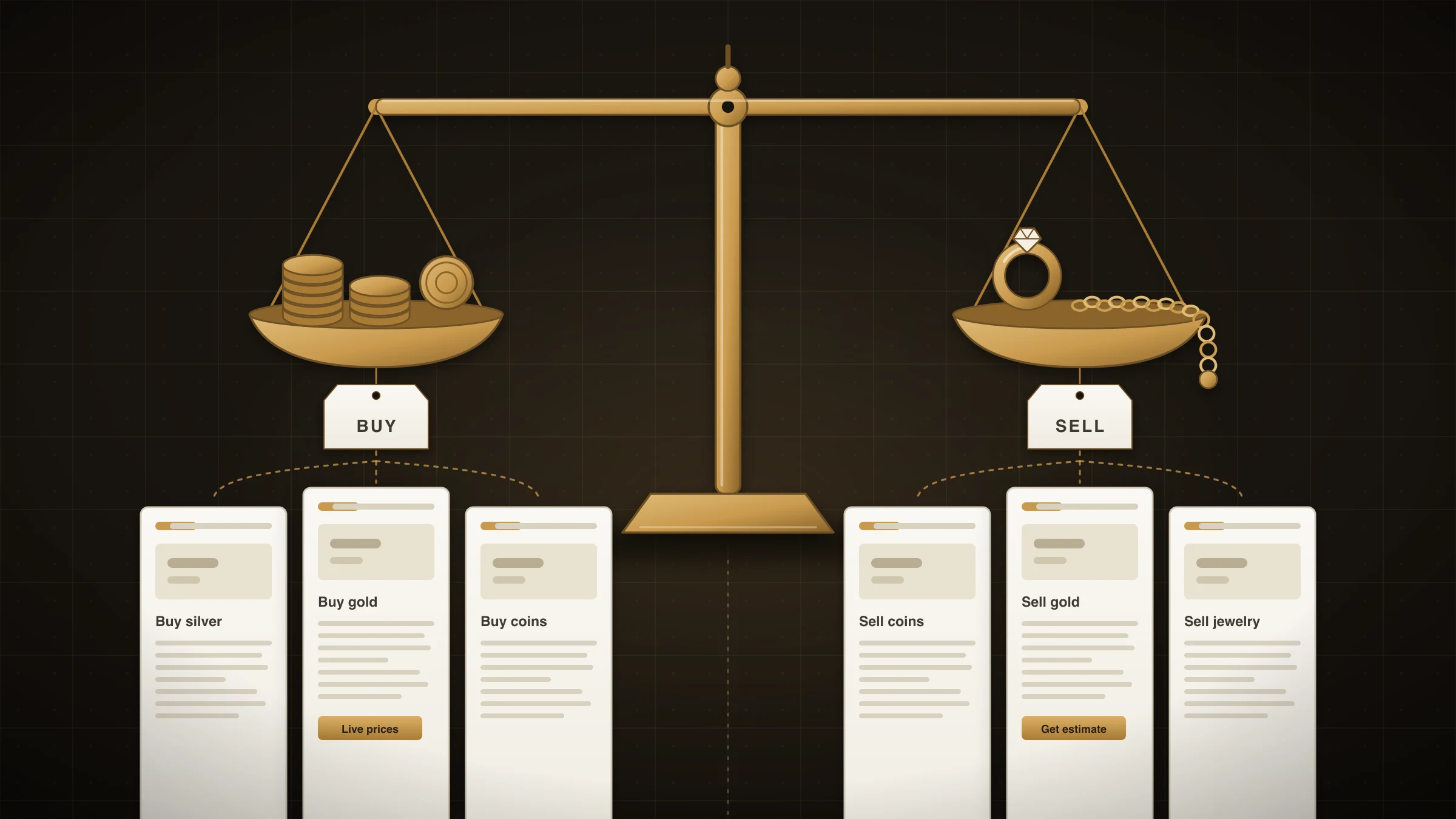
Most advice on coin shop marketing treats the shop as one business with one customer. Stand behind the counter for a day and you know that is wrong. One person walks in to buy a tube of silver rounds. The next is carrying her mother's jewelry box and wants to know what it is worth. They did not search the same words, they are not worried about the same things, and a page written for both of them persuades neither.
This is a field note on how we handled that for Bullion Reserve, a gold and coin dealer in Metro Detroit. It is the thinking behind our websites for jewelers and gold buyers, and it carries over to any business with two kinds of customer.
The problem: one counter, two customers
A dealer has a buyer and a seller, and they are close to opposites.
The buyer is putting money into metal. They know the product names, they want today's price and what is in the case, and they compare.
The seller is turning metal into money, often for the only time in their life. They want a rough idea of the offer before they drive over, and they want to feel they will be treated fairly.
Both have had reason to turn up lately. The World Gold Council, the industry's trade body, reports that the gold price set 53 new all-time highs during 2025, and that jewellery demand fell 19% by weight while its value rose to a record. Those are worldwide figures, not Michigan ones, but any counter owner will recognise the effect: a high price brings out people who want to own metal and people who have just realised the drawer of old chains is worth something.
What we looked at: buy and sell intent, word by word
Before drawing a single page, we wrote down what each customer types. Gold shop keywords sort into three piles.
Words that name a direction. "Buy silver bars." "Sell gold jewelry." The searcher has told you which side of the counter they are on.
Words that name the place. "Coin shop near me." This person wants a counter to walk up to, and could be either customer.
Words that name neither. A bare "gold" or "silver." You cannot tell what they want from the query.
The decision: one intent per page, two sealed funnels
For Bullion Reserve we built two funnels that do not blur. A buy hub sits above pages for bars, government-minted coins and retirement accounts. A sell hub sits above pages for estate jewelry, coins, scrap gold, silver and sterling, and bullion. A separate page owns the shop as a place, for the person searching for a coin shop rather than a transaction.
Two rules hold it together.
Every search phrase has one owner. Other pages may mention the phrase in passing, and they link to the page that owns it. In our work, two pages on one site aimed at the same phrase tend to get in each other's way. The word "coins" shows how fine the split can be: one page for the shop as a place, one for selling coins, one for buying them.
The funnels are sealed. A buy page links to other buy pages and to the handful of pages that serve both customers. A sell page does the same on its side.
There is outside support for giving each service its own page. In Whitespark's 2026 Local Search Ranking Factors survey of 47 local search experts, a dedicated page for each service was ranked the second most important factor for visibility in AI search. That is expert opinion, not a measurement from Google.
The lesson: an ad rule is not a site rule
This one is on us. When we planned the pages we borrowed a rule from advertising. In an ad campaign aimed at sellers it is reasonable to block a buyer's word like "bullion": the wrong visitor costs money, so you cut broad words out.
We carried that rule into our page plan: no sell page was allowed to use the word. That was our mistake, and we reversed it. People search "sell bullion" and "bullion buyer." Those queries name their own direction. A seller who types one can only be a seller, so a sell page that answers it takes nothing from the buy side.
So Bullion Reserve now has a sell page for bullion, and the buy hub keeps the buying side of the word.
The point for bullion dealer marketing, and for anyone else: an ad rule exists to stop you paying for the wrong visitor. A page costs nothing when the wrong person skips it. Do not copy one rulebook into the other.
What was built
A live spot price board. Buyers see current metal prices on the site, fed from a market data source.
A sell estimator. A seller lists what they have (the material, the item, the weight) and sees an estimated range based on the day's spot price. If they want one figure for the whole lot, they leave a name and an email, and the request arrives at the shop as a lead, tagged with the page it came from.
Evaluation booking. A seller can book a time to bring items in and attach photos, with the available times following the hours the owner sets.
Location pages with their own copy. Each area the shop serves has a page marked as buy, sell or both, and each must say something specific to that area. Automated checks reject a page that repeats another's copy.
Google's spam policies define doorway abuse as "sites or pages are created to rank for specific, similar search queries" that lead visitors to pages less useful than the final destination. A stack of town pages with only the name swapped is, as we read it, what that definition describes. You can see the finished site in our portfolio.
Coin shop marketing lessons for any trade
You do not need to sell gold for this to apply. An equipment dealer sells machines and takes trade-ins. A consignment shop has shoppers and consignors. A staffing firm has employers and job seekers.
Name your audiences.
List the words each one types, and sort them: names a direction, names the place, names neither.
Give each phrase one owner page.
Link within a funnel, not across it.
Give each funnel its own next step. A buyer wants a price. A seller wants an estimate.
One caution. If you have one kind of customer and five services, do not build two funnels. A clear page per service is enough.
The next step
If your site talks to two audiences on the same pages, sorting the words is an afternoon's work. We do this as part of our local SEO work, and we will look at your current pages and tell you where the two customers are tripping over each other. The first review is free: get in touch.
Comments
Be the first to comment.